

What’s left on the Iowa Supreme Court’s 2012-2013 docket

By: Administrator on June 19th, 2013

By Ryan Koopmans and Michael Currie

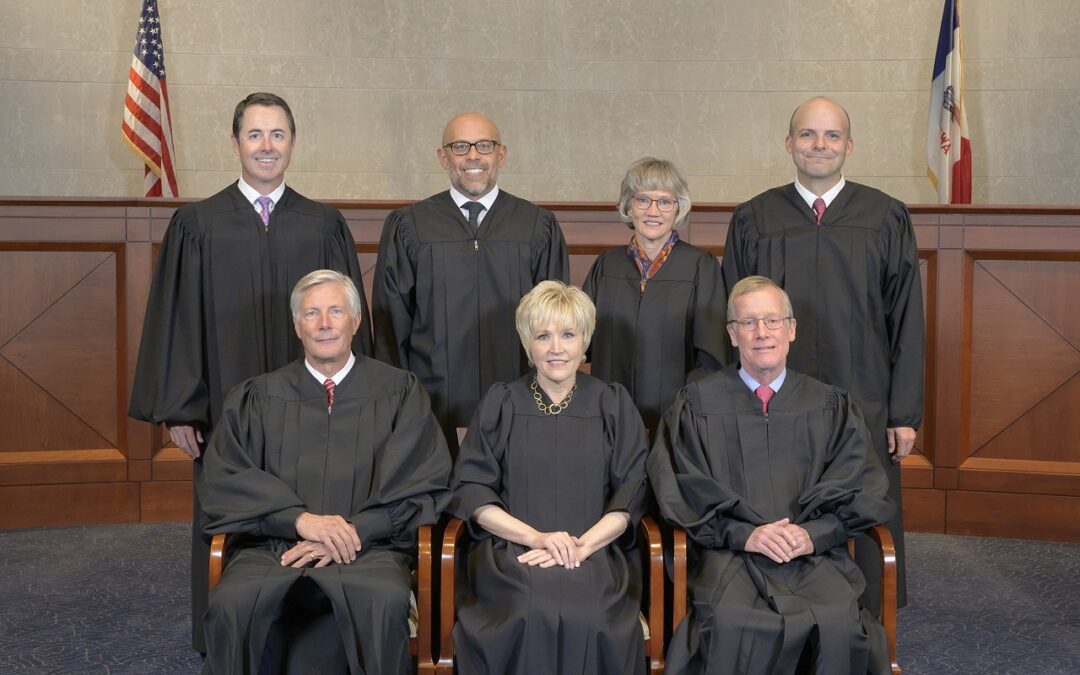
The Iowa Supreme Court’s 2012-2013 term ends on June 30, and the justices’ self-imposed goal is to issue decisions in all remaining cases by then (or a short time after).  The Court’s docket this term consisted of 96 cases, and the Court has filed a decision in 76 of them.  One case (Stotler v. Delevan, Inc.) settled days before oral argument; and the Court recently dismissed another case (St. John’s Full Gospel Baptist Church v. Tax 207 and Polk County Treasurer) as improvidently granted—meaning that the Court granted further review but decided, after close study, that the case did not meet its acceptance criteria.

That leaves 18 cases outstanding.  Below the jump is a list of those cases (in the order they were submitted to the Court) along with a few brief comments.


More Analysis on Iowa Right to Life v. Tooker: Less Disclosure, Future Litigation

By: Administrator on June 13th, 2013

By Colin Smith

Today’s Eighth Circuit ruling in Iowa Right to Life v. Tooker is the most significant Iowa election law case in memory and its legal conclusions will have an impact in Iowa and beyond.  As we have discussed before, the Tooker case began when Iowa Right to Life filed a legal challenge to several provisions of Iowa’s campaign finance statute.  Iowa Right to Life was unsuccessful in the lower courts.  However, led by the prolific conservative election lawyer James Bopp Jr., Iowa Right to Life has found a reversal of fortunate on appeal at the Eighth Circuit.

On appeal, Iowa Right to Life made four distinct arguments, but only three of them are significant (the fourth argument was dismissed for lack of standing).  The three arguments dealt with different issues: Iowa’s corporate political spending disclosure rules, Iowa’s ban on direct corporate contributions to candidates running for office, and Iowa’s requirement that a corporation obtain prior authorization from its board of directors and officers before engaging in political spending.  The Eighth Circuit today struck down the majority of Iowa’s disclosure requirements, upheld the state ban on corporate contributions, and struck down, in part, Iowa’s board and officer authorization rules.  The following is a detailed analysis of some of the important aspects of today’s decision.


BREAKING: Eighth Circuit Strikes Down Part of Iowa’s Election Laws As Unconstitutional

By: Administrator on June 13th, 2013

By Colin Smith

The opinion in Iowa Right to Life v. Tooker—a case we predicted would be a blockbuster—was handed down by the Eighth Circuit Court of Appeals this morning.  While I have only had the opportunity to skim the lengthy opinion at this point, the following appears to be the result of the case:


Iowa: Where the potential SCOTUS nominees roam

By: Ryan Koopmans on May 23rd, 2013

ThinkProgress editor Ian Millhiser speculates today on whom President Obama might select as his next Supreme Court nominee.  On the list: Cedar Rapids resident and newly confirmed Eighth Circuit Judge Jane Kelly.

So Iowa is now 2 for 2 on Eighth Circuit judges and potential Supreme Court shortlisters.  Two active Eighth Circuit judges call Iowa home: Steve Colloton and Jane Kelly.  And before the election last fall, Judge Colloton was listed as a potential Romney nominee.  (See here and here.)

We must be doing something right in the Hawkeye State.


Supreme Court to issue birth-certificate decision tomorrow

By: Ryan Koopmans on May 2nd, 2013

Tomorrow, the Iowa Supreme Court will decide whether the presumption of paternity–whereby the husband is presumed to be the father of his wife’s child, and therefore listed on the birth certificate–must apply to a same-sex spouse under the Iowa Constitution’s Equal Protection Clause.  The case, Gartner v. Iowa Department of Public Health, was argued in December and is one of the most anticipated Iowa Supreme Court decisions of this term.

Heather and Melissa Gartner married in 2009, shortly after the Iowa Supreme Court ruled in Varnum that Iowa’s ban on same-sex marriage violated the Iowa Constitution. In September of the same year, Heather gave birth to a daughter, who was conceived by artificial insemination through an anonymous donor.

Heather and Melissa requested that both of their names be placed on the birth certificate, but the Iowa Department of Public Health listed Heather only.  Melissa could be added, the Department told them, but only if she adopted the child because Iowa’s birth-certificate statute is based on paternity: “Unless paternity has been determined otherwise by a court” the “name of the husband shall be entered on the certificate as the father of the child.”

The Gartners challenged that decision in Iowa District Court and won.  Judge Eliza Ovrom ruled that in light of Varnum, the birth-certificate statute must be interpreted in a gender-neutral fashion: “husband” should be read as “spouse” and “father” should be read as “parent.”

The Department appealed the ruling, arguing that the gender-specific nature of the statute has meaning beyond marriage–that it goes to paternity and therefore that Varnum does not affect the statute.

The briefs in the case are linked below:

Iowa Department of Public Health Opening Brief
Gartner Brief
Amicus brief of the Family Policy Center in support of the Department
Amicus brief of the ACLU in support of the Gartners
Amicus brief of the National Association of Social Workers in support of the Gartners
Amicus brief of law professors in support of the Gartners


Judge Jane Kelly

By: Ryan Koopmans on April 24th, 2013

By a vote of 96-0, the Senate has confirmed Jane Kelly to serve as a judge on the United States Court of Appeals for the Eighth Circuit.

Kelly, a federal public defender from Cedar Rapids, sailed through the confirmation process.  President Obama, a law school classmate of Kelly’s, nominated her on January 31, and the Senate Judiciary Committee approved that nomination by voice vote on March 22.  Her confirmation today sets a speed record for a President Obama circuit-court nominee.

Kelly graduated from Harvard Law School in 1991.  She then clerked successively for South Dakota Federal Judge Donald Porter and Eighth Circuit Judge David Hansen.  From 1993-1994, she taught at the University of Illinois College of law, and since 1994 she’s worked as an assistant federal public defender in Cedar Rapids.

For more on Kelly and her sprint through the Senate, see this post by Todd Ruger at the Blog of LegalTimes.


Koopmans talks Iowa Supreme Court decisions on IPR’s River to River

By: Administrator on April 5th, 2013

Last week on Iowa Public Radio’s River to River, On Brief contributor Ryan Koopmans and University of Iowa law professors Song Richardson and Todd Pettys discussed four high-profile cases from the Iowa Supreme Court’s 2012-2013 term: Gartner v. Iowa Department of Public Health, Nelson v. James H. Knight DDS, P.C., State v. Kooima, and State v. Ragland. The hour-long segment is available here.


Iowa Supreme Court splits 4-3 in bar-fight case

By: Ryan Koopmans on April 5th, 2013

Bar Patron A taunts Bar Patron B, but B doesn’t respond in kind.  The bar owner, wanting to avoid a fight, kicks A out of the bar, but B, who had remained calm during this entire time, goes out to the parking lot and assaults A.  Is the bar liable to A (the initial aggressor) for his injuries?  Maybe, according to a four-justice majority of the Iowa Supreme Court.

That’s the ruling today in Hoyt v. Gutterz Bowl and Lounge L.L.C. In the spring of 2009, Curtis Hoyt and his coworkers stopped at Gutterz, the local bowling alley in Guthrie Center, Iowa for an after-work beer.  A few beers into his visit, Hoyt and his coworker, Chris Brittain, began taunting another patron, Curtis Knapp.  Apparently there was some bad blood between Hoyt and Knapp; something about Knapp disrespecting someone’s sister.

The bartender–who had no knowledge of the bad blood– interjected, telling Hoyt that he was going to be “cut off” if the taunting continued.  Hoyt didn’t stop, and Gutterz’s owner ultimately kicked him out. During that entire time, Knapp stayed calm; he didn’t raise his voice or otherwise respond to Hoyt’s taunts.  But Knapp couldn’t take it anymore. Soon after the bartender kicked Hoyt out of the bowling alley, Knapp also left.  He encountered Hoyt in the parking lot and assaulted him.

So Hoyt (the initial aggressor) is suing the bowling alley.  Why?  Well, according to Hoyt, the bowling alley employees should have done more to protect him from himself.  Hoyt argues that when he acted inappropriately, the bartender should have called the police (on him, apparently).   Or, at the very least, the bowling alley employees should have made certain that he (Hoyt) got into his car and left.

That argument didn’t work in the district court.  The bowling alley filed for summary judgment, and the judge granted the motion, saying that the bowling alley had done all it needed to do: It ejected Hoyt (the misbehaving party), and there was no reason to believe that Knapp (the innocent party) would assault Hoyt in the parking lot.

By a vote of 4-3, a majority of the Iowa Supreme Court disagreed with that ruling.  Justice Hecht, joined by Justices Wiggins, Appel, and Zager, concluded that, given the “general tenor of bar behavior” and the bar owner’s worry that a fight might break out (that’s why he ordered Hoyt to leave), “a reasonable person might find the risk of harm to Hoyt foreseeable,” and thus a reasonable jury may very well find that the bowling alley must pay Hoyt for his injuries.

Justice Waterman dissented, joined by Chief Justice Cady and Justice Mansfield.  They, like the district court, agreed that the bowling alley could not be found responsible for Hoyt’s injuries:

Having kicked out the troublemakers—Hoyt and his companion—what else should Guttzerz have done? How was the bar negligent? The majority concludes a jury could find Gutterz negligent for failing to call the police. But, no crime had (yet) been committed, and Hoyt exited the bar when told to leave. Knapp was not threatening anyone or misbehaving in any way. At that point, why call the police? From Gutterz’s standpoint, the incident had been defused by Hoyt’s departure. The majority also argues Atkinson should have done more to ensure Hoyt left the parking lot safely. This theory assumes Atkinson reasonably should have foreseen Knapp would attack Hoyt. Knapp had not so much as even raised his voice. The majority fails to cite a single case from any jurisdiction supporting a property owner’s liability for a third-party assault under equivalent facts.

Justice Waterman concludes with this: “It is an ‘excessive precaution’ to require [Gutterz's owner] to call the police after he ejected Hoyt or to guard Hoyt outside until he left unharmed when there were only two employees working at Gutterz that afternoon, and Knapp had given no sign of trouble.”

So what are the takeaways from the Hoyt decision?  For bar and restaurant owners: It’s not enough to kick out an aggressive bar patron; unless you want to pay the cost of litigation and a full trial, your employees should call the police every time one patron taunts another, or, at the very least, they should personally escort every trash-talker to his car.

The takeaway for police departments: You’re going to need more officers.


Anonymous Tips and Juvenile Sentencing: A Criminal End to the Iowa Supreme Court’s 2012-2013 Term

By: Ryan Koopmans on March 11th, 2013

Before wrapping up its 2012-2013 oral argument calendar in April, the Iowa Supreme Court will hear two constitutional cases with potential national consequences.

Tomorrow, the seven-member court will travel to Sioux City to hear argument in State v. Kooima.  At issue: whether, under the Fourth Amendment, a police officer may stop a vehicle based solely on an anonymous tip that the driver is drunk.  That issue has split state and federal courts, meaning that the Iowa Supreme Court’s decision (whichever way it goes) may be ripe for U.S. Supreme Court review.

Then, on April 9, the Court will hear argument in State v. Ragland. At issue there: whether a mandatory sentence of life in prison with the possibility of parole after 60 years for a juvenile murderer amounts to cruel and unusual punishment.  Last year, the U.S. Supreme Court ruled in Miller v. Alabama that states may not automatically sentence juvenile murders to life without the possibility of parole.  Following that ruling, Iowa Governor Terry Branstad commuted the sentences of 38 juvenile murderers from life without parole, to life with the possibility of parole after 60 years.  Several of those offenders, including Jeffrey Ragland, think that’s still too long under Miller. Depending on what the Iowa Supreme Court says, this case could also end up in the U.S. Supreme Court.


Eighth Circuit Grants Rehearing En Banc to Settle Intra-Circuit Split

By: Ryan Koopmans on March 4th, 2013

Today, the Eighth Circuit ordered rehearing en banc in United States v. Bruguier and United States v. Rouillardtwo cases that were issued on the same day with opposite results.

We reported on Bruguier and Rouillard in December of last year. In both cases the defendants were convicted of “knowingly . . . engaging in a sexual act with another person if that other person is–(A) incapable of apprising the nature of the conduct; or (B) physically incapable of declining participation in, or communicating unwillingness to engage in, that sexual act.”  Both defendants argued that the “knowingly” requirement extends to subsections (A) and (B)—that is, the government must prove that the defendant knew the victim was mentally or physically impaired.  The government argued in both cases that the mens rea requirement doesn’t extend beyond the first clause.

A majority of the Bruguier panel agreed with the government.  The Rouillard panel agreed with the defendant.

The full 11-member court (plus Senior Judge Bright, who dissented in Bruguier) will hear oral argument on April 12 in St. Louis.


On Brief

About Us

On Brief is devoted to appellate litigation, with a focus on the Iowa Supreme Court, the Iowa Court of Appeals, and the United States Court of Appeals for the Eighth Circuit.


Links